Showing posts with label Books. Show all posts

Monday, 24 March 2014

Second hand books

I've always enjoyed reading but never used to like buying books.  I don't know why, but in the last couple of years that's all changed.  I love buying books now.  There's something inexplicably thrilling about filling up my bookshelf spaces with new volumes waiting to be read, or great works I've already head the pleasure of reading and want to keep forever.

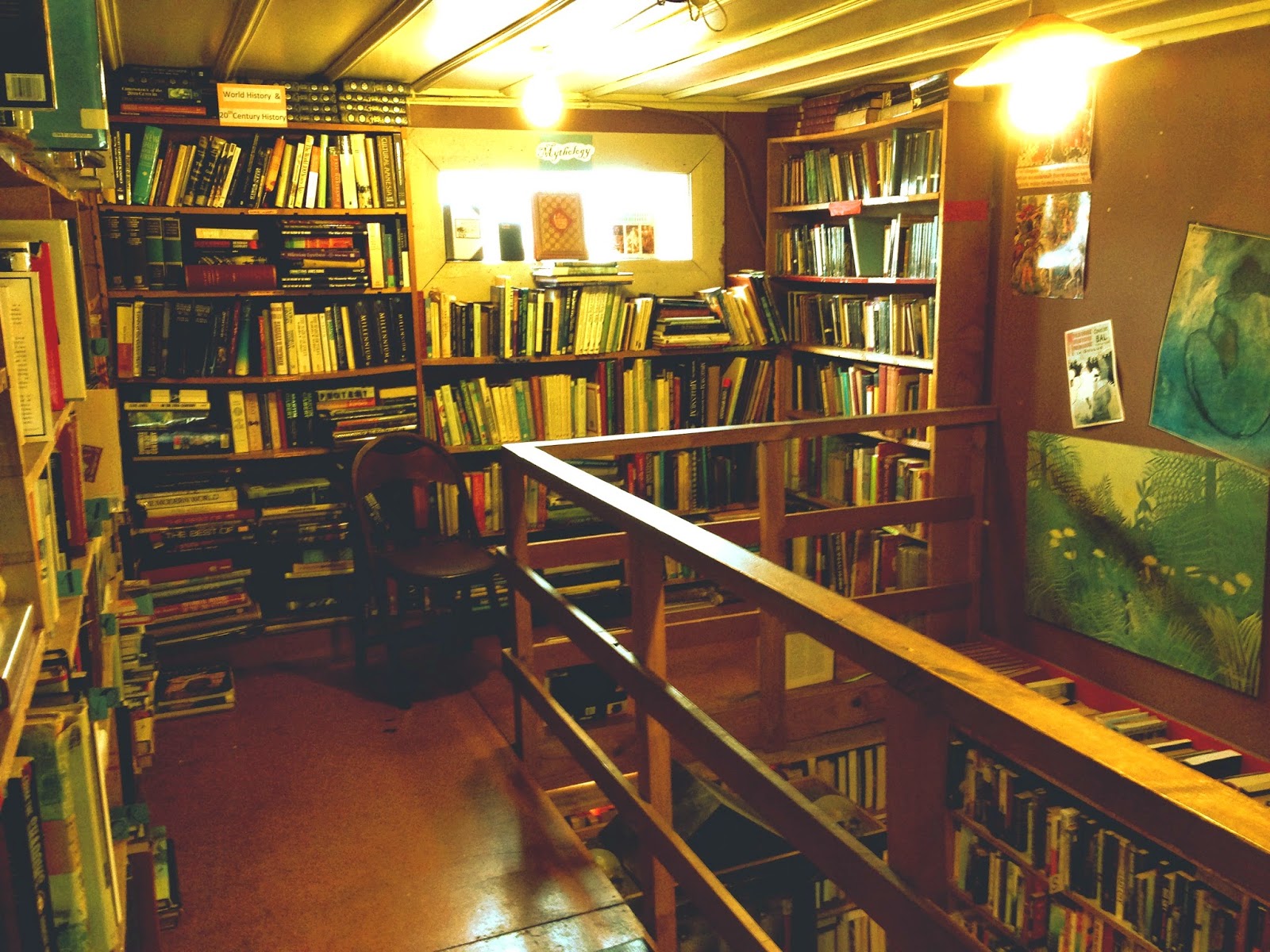
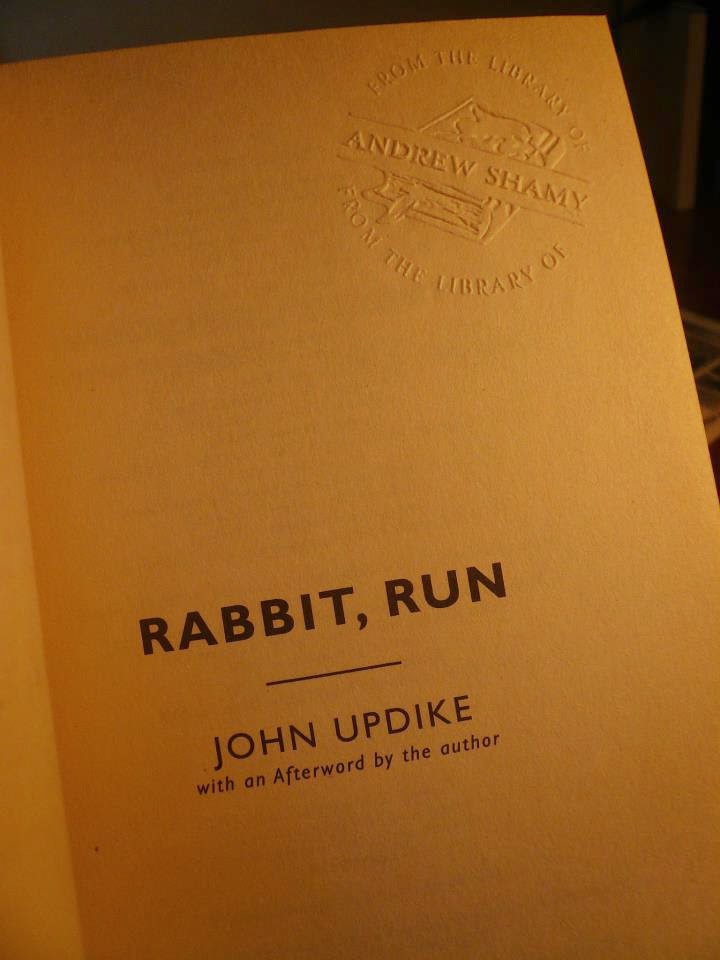
As a subset category of book-buying, I've really gotten into second hand books.  They're super cheap, for one.  And for another, it's a real rush exploring the chaos that is your typical second hand bookshop and finding a book (or two, or three, whatever) that you've been dying to get your hands on.  Also, it's quite neat to hold a pre-loved book in your hands and thumb through pages that have already been thumbed through by another person.  It's like the previous owner of the book is passing on the story to you and you're connected to that person through it.  One time I bought a book from my neighbourhood second hand bookstore (details below) and it turned out to have once belonged to a friend of mine - I know this because he has an extensive private library and he marks all his books with a personalised seal.

Decent book, too.

I have a couple of favourite second hand bookstores that I enjoy visiting.  One is the local second hand bookstore in Tirau, "I Spy Books", which I try to visit every time I'm down there staying with my family.  For a second hand bookstore that's located in a town comprising a main street that spans 500 metres, it's really decent.  I manage to find a book or two to purchase each time I pop in.  At the moment I'm reading "The English Patient" by Michael Ondaatje that I got from this store a couple of months ago (it's very good).

So many books.

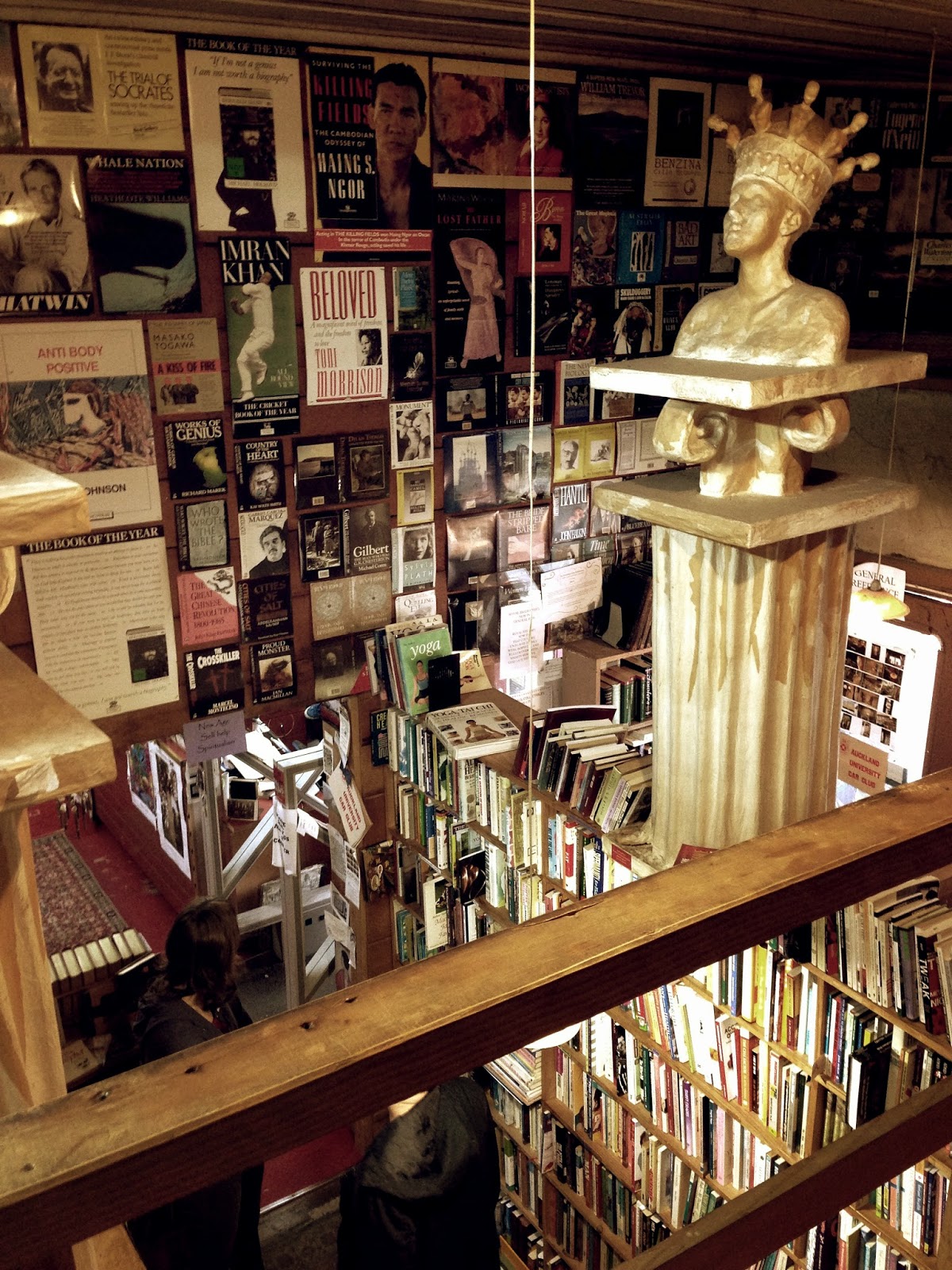
The other is the gigantic second hand bookstore in Onehunga, "Hard To Find".  In fact, I think it's the biggest second hand bookstore in New Zealand.  There are multiple storeys with the walls and much of the floorspace lined with bookshelves that are jam packed - it's easy to lose track of time when as you walk through the labyrinth of volumes in the store.  My latest "Hard To Find" purchase was "Pure" by Andrew Miller (it was also very good).

Heaven.
More than just books.  Watch out for the weird
stuffed man dolls they have lying around everywhere.

It's been a while since I've been second hand book shopping - I should rectify this.  It's neither here nor there that my bookshelves are already full of books I still have to read.

G.

Monday, 4 June 2012

The book thief

Last night I read Markus Zusak's "The Book Thief". All of it, 554 pages, in one go. I just couldn't stop reading - it was that good. "It's a small story about a girl, an accordionist, some fanatical Germans, a Jewish fist fighter and quite a lot of thievery."


The book is set in Nazi Germany. The main character of the story is Liesel, a young girl who is put in the care of foster parents by her mother because the authorities are targeting her own parents for being communists. On the journey to her new foster home, Liesel's six-year-old brother dies, and this traumatises her. At his sudden funeral, one of the gravediggers accidentally drops a book, and Liesel steals it. She will later acquire a taste for stealing books - she is the book thief of the title.

Liesel's foster father, Hans Hubermann (Papa), is a gentle and kind soul who instantly bonds with her. Her foster mother, Rosa Hubermann (Mama), is a foul-mouthed and hot-tempered lady who puts on a tough front but deep down loves her husband and loves Liesel. Papa is a trade painter who plays the accordion, Mama does the washing and ironing for rich people in the neighbourhood. They live on Himmel Street, one of the poorest streets in the township of Molching. Papa has always been kind to Jews, which has made life difficult for the family. Liesel becomes best friends with the boy next door, Rudy Steiner, who loves Jesse Owens and once painted himself black with charcoal and ran the 100 metre track at the local racecourse to imitate his hero.

Liesel is haunted by nightmares of her family (especially her dead brother) and wakes up almost every night. Her Papa always comforts her. One night, the gravedigger's book that Liesel stole falls out from its hiding place in the mattress, and Papa begins to teach the illiterate Liesel how to read. Once Liesel becomes literate, she begins to hunger for books. Her hunger is satiated somewhat by the mayor's wife, one of Mama's clients, who lets Liesel into the huge library at the mayor's home and read whatever she wants for as long as she wants. Liesel develops the habit of stealing books, and her primary target becomes the mayor's library, the reason for this being that the mayor's wife fires Mama once Germany became officially embroiled in World War II (tough times, not enough money to keep hiring to someone to do one's washing and ironing). She begins to steal other things too (mostly food), usually with Rudy as her crime partner. (It turns out that the mayor's wife had known of Liesel's book thievery all along, and even left the window open for Liesel to come in and steal from her library. But anyway.)

One day, a Jew named Max Vandenburg comes to the Hubermann residence. It transpires that Max is the son of a friend of Papa who saved Papa's life in World War I, and Papa promised the friend's (who died in battle) family that he would do anything to help them. Max had been living in hiding from Nazi soldiers for two years, and he had come to the Hubermann's house to see if they would hide him. Papa keeps the promise he made decades ago and hides Max down in the basement. Max and Liesel quickly become friends. Max used to be a fist-fighter. To pass the time, he works out, does crossword puzzles in newspapers that Liesel forages for him, writes down his thoughts and writes stories for Liesel. One day, when a throng of starving and sickly Jewish people are being marched through the town to the nearby concentration camp by Nazi soldiers, Papa instinctively offers one of them bread, and this catches the eye of one of the soldiers and most of the neighbours. Papa fears that the Nazi Party will target him and raid the house, which would result in them discovering Max. Everyone agrees that Max should leave the house for a while and come back in a few days. However, Max doesn't ever come back. Papa's fear is confirmed when he is sent off by the Party to help in the war efforts. Miraculously, he survives.

When the air raid threats arrive, several houses of Molching with deep basements are designated to be bomb shelters. The residents experience numerous air raid warnings as the war deepens, but each time, nothing happens to the town. Liesel keeps an eye out every time the soldiers march Jewish concentration camp prisoners through the village, to see if Max might be a part of the crowd. She does meet Max one day, an unbelievable miracle - he had been captured on the way to Stuttgart. Liesel also decides to write to the mayor's wife apologising for stealing books, and the mayor's wife gifts her with a notebook to write in: if she wasn't going to read any more books from the library, perhaps she might like to write one instead.

One night, bombs fall on Molching while everyone is sleeping. The Allies tricked the German army and no air raid sirens are heard. Liesel is the only one to survive, because she had been in the basement of her own home, writing down the story of her life in the notebook given to her by the mayor's wife. Later, when the war is over, she is reunited with Max.

It may not be apparent from the poor way I laid out the plot but as I said earlier (there's a much more comprehensive plot summary on Wikipedia if you want to check that out), this was a great read. The story jumps around a bit in time in certain places but that kept things interesting, kept up the suspense, and it wasn't confusing at all. The most unique thing about the book was that the story is told by Death, which made the whole thing super interesting. Because of this narrative device, parts of it were quite poignant, particularly when Death is reflecting on human nature and war. Zusak writes really well, very poetically and beautifully. Check out some of the prologue:

"I could introduce myself properly, but it's not really necessary. You will know me well enough and soon enough, depending on a diverse range of variables. It suffices to say that at some point in time,  I will be standing over you, as genially as possible. Your soul will be in my arms. A colour will  be perched on my shoulders. I will carry you gently away.
   At that moment, you will be lying there (I rarely find people standing up). You will be caked in your own body. There might be a discovery; a scream will dribble down the air. The only sound I'll hear after that will be my own breathing, and the sound of the smell, of my footsteps.
   The question is, what colour will everything be at that moment when I come for you? What will the sky be saying?
   Personally, I like a chocolate-coloured sky. Dark, dark chocolate. People say it suits me. I do, however, try to enjoy every colour I see - the whole spectrum. A billion or so flavours, none of them quite the same, and a sky to slowly suck on. It takes the edge off the stress. It helps me relax."

Another part of the book I really enjoyed was the second story that Max wrote for Liesel, called "The Word Shaker". A part of the story is that the Fuhrer, Adolf Hitler, craftily used words to achieve his objective of taking over the world. It struck me deeply because it's true. Hitler's tyranny began, and was sustained, with a bunch of well-chosen, powerful words. Max's second story begins like this:

"THERE WAS once a strange, small man. He decided three important details about his life.
  • He would part his hair from the opposite side to everyone else.
  • He would find himself a small, strange moustache.
  • He would one day rule the world.
The young man wandered around for quite some time, thinking, planning and figuring out exactly how to make the world his. Then one day, it struck him - the perfect plan. He'd seen a mother walking with her child. She admonished the small boy at length, until finally, he began to cry. Within a few minutes she spoke very softly to him, after which he was soothed and even smiled.
   The young man rushed to the woman and embraced her. "Words!" he grinned.
   "What?"
   But there was no reply.
   He was already gone.

Yes, the Fuhrer decided that he would rule the world with words. "I will never fire a gun," he said. "I will not have to." Still, he was not rash. Let's allow him at least that much. He was not a stupid man at all. His first plan of attack was to plant the words in as many areas of his homeland as possible.
   He planted them day and night, and cultivated them.
   He watched them grow, until eventually, great forests of words had risen throughout Germany... It was a nation of farmed thoughts."

Captivating. 

I'd totally recommend "The Book Thief". It's a wonderful read.

G.

Wednesday, 23 May 2012

The vertical self

Last weekend I read "The Vertical Self" by Mark Sayers. Like "Brave New World" it had been on my reading list for some time. It was awesome.


The book explores the theme of identity; more specifically, the struggles we experience with the question of identity, and the meaning and value we both give to and find in who we are. Sayers argues that today, we no longer know who we truly are, because we all buy into to a horizontal sense of self: the individual derives his or her identity from the world - culture, other people, celebrities, the media - in a "sideways" fashion. For people who hold a horizontal sense of self, the creation and cultivation of a public image are paramount, and society both reflects and dictates who they are. Moreover, the horizontal self makes us narcissistic and self-conscious, as we feel the need to constantly groom our public personas to win the validation of others.

Sayers states that that the concept of the horizontal self is a mistaken way of tackling the question of identity, and suggests that the contrasting idea of vertical self provides the real answer to understanding who we are. "The vertical self is defined by being part of a greater reality. This worldview leads to a belief in the eternal, the desire to cultivate one's spirituality so that one moves upward on the path toward becoming more like God." People with a vertical sense of self look "upwards" to understand who they are.

Building on the Christian premise that humans are made in the image of God, Sayers proposes that in order to understand who we are and find our real identities, we must re-image ourselves in the image of God. The identity of every human being is rooted in his or her God-given image, and we need to return to that basic principle to truly know ourselves and be comfortable in our own skin. In order to do this, we have to rediscover what it means to be holy.

Moreover, Sayers says that in this life, you're not the real or true you; the real or true you is the redeemed in the new heavens and new earth. This redeemed you is basically you minus all the effects of sin and death. This redeemed you is yourself, but with your positives amplified, your talents expanded, and your maturity fulfilled. Though you won't be able to fully become your real or true self in this life, you can and should journey towards becoming the real or true you more and more. Again, the answer is holiness.

Holiness isn't about impossible perfectionism. It's about wholeness. It's about getting rid of sarx: anything in life - attitudes, relationships, actions, desires or worldviews - that carries with it the spirit of death and corruption. It's about placing our inherent impulses and wants under God's sovereignty. It's about shalom, perfect peace and balance with the world around us. It's about submitting to and being secure in Christ.

I don't know if I can say with confidence that I really know who I am. Who I am seems to change a lot depending on who I'm with, what I'm doing and where I am. I'm still figuring it out and I'll probably spend the rest of my life wrestling with questions of identity. Maybe I'm equally and entirely all the persons that I am at different times and situations. But overall, it's encouraging to know that I can look to the most awesome person ever to gain a true sense of self, and I'm hoping to tread the path of holiness until the end of this life as I look upwards.

G.

Monday, 14 May 2012

Brave new world

Last year, I joined an online book club, and I decided that at the beginning of each year I would set myself a list of all the books I want to read within that year. I only managed to get through half of the books on my 2011 list. I'm hoping that I get to tick off all the books on my 2012 list. One of the books on this year's reading list was "Brave New World" by Aldous Huxley. And oh man, it was amazing.


"Brave New World" is set in an imagined future world (called the World State) where human beings are created in laboratories (Hatcheries and Conditioning Centres) to be a certain class (ranging from Alpha, the best class, to Epsilon, the lowest class) and thus fulfil certain predetermined positions and roles in society. They are bred and conditioned to be think in certain ways, to behave in certain ways and to desire certain things. Consumption is extolled and people worship an entity they call "Our Ford",  evidently the being who pioneered this new world and lifestyle. Recreational sex (and recreational sex only, not reproductive sex) is an essential part of life, whereas the concept of family and parenthood are outlawed as being "unnatural". People are encouraged to socialise and pursue entertainment; solitude is considered to be terrible. Conformity is good, individualism is bad. There is no literature, no poetry, no genuine art. The ultimate good in this world is happiness, and people regularly take a drug called soma to experience hallucinogenic pleasure. Outside the boundaries of this world, there exist "Reservations" which are populated by "Savages": people who live primitively in indigenous communities, without soma, and reproduce naturally. Bernard Marx, an Alpha psychologist, feels like an outsider in society despite being in the highest social class. In order to impress a fellow alpha named Lenina Crowne, Bernard asks his friend Helmholtz Watson to arrange a trip for the two of them to a nearby Savage Reservation. To their surprise, they discover two Savages who belong to the World State: Linda, a former lover of the Director of the Hatcheries and Conditioning Centre where Bernard works, and their naturally conceived son, John. Bernard brings Linda and John back to the World State, where John (who becomes known as "the Savage") becomes an instant commodity. However, John becomes disillusioned with this society, and after struggling with Lenina's sexual advances (he comes to both adore and hate her) and seeing his mother die of a soma overdose, he instigates a riot, getting Bernard and Helmholtz into trouble as well. Mustapha Mond, the Resident World Controller for Western Europe, exiles Bernard and Helmholtz from the World State as punishment. John retreats to a lighthouse outside the city for a life of solitude, but is constantly plagued by people from the civilised world who want to get a sight of the Savage. One day, a whole bunch of people including Lenina visit him, and at the sight of her, John loses his mind and attacks her, which drives the people wild and escalates to crowd violence and an orgy. The next day, John hangs himself in shame and self-loathing.

I really enjoyed reading this book. It hit me with all these questions and thoughts about what it means to be human and what it means to live well. I think I particularly like dystopian novels (though "Brave New World" doesn't technically isn't a dystopian story, more like a false utopian story, but anyway) because they highlight these issues by presenting a society where people are no longer fully human nor living well because certain values and ideals are missing (e.g. liberty, free speech), and make you realise that those absent values and ideals must be essential aspects of the truly human, good life. In the England of "Brave New World", there is happiness and pleasure, but these are enjoyed at the cost of true freedom and choice. While happiness and pleasure are important elements or goals of human life, they are not genuine here. If someone isn't happy, s/he is considered to be strange. Pleasure is rammed down people's throats - quite literally, in the form of soma - so that they are constantly, artificially kept happy. The book portrays the consequences of taking Jeremy Bentham's hedonistic utilitarianism to the utmost extent: do what feels good and what makes you feel happy, because that's the ultimate good and the meaning of life. 

Philosophies clash in the intriguing conversation about the good life between John the Savage and Mustapha Mond, which takes place after the riot. The Savage champions liberty/freedom, while the Controller esteems happiness/stability, and these values are presented as being incompatible, as freedom is seen as being causatively linked to pain, suffering and unhappiness. 

"[O]ur world is not the same as Othello's world. You can't make flivvers without steel - and you can't make tragedies without social instability. The world's stable now. People are happy; they get what they want, and they never want what they can't get. They're well off; they're safe; they're never ill; they're not afraid of death; they're blissfully ignorant of passion and old age; they're plagued with no mothers or fathers; they've got no wives, or children, or lovers to feel strongly about; they're so conditioned that hey practically can't help behaving as they ought to behave. And if anything should go wrong, there's soma. Which you go and chuck out of the window in the name of liberty, Mr. Savage. Liberty!"

"You've got to choose between happiness and what people used to call high art. We've sacrificed the high art ... Actual happiness always looks pretty squalid in comparison with the over-compensations for misery. And, of course, stability isn't nearly so spectacular as instability. And being contented has none of the glamour of a good fight against misfortune, none of the picturesqueness of a struggle with temptation, or a fatal overthrow by passion or doubt. Happiness is never grand."

People don't know any better than the lot they are dealt with at the Hatchery and Conditioning Centre. They neither want more nor less than what they are created to want. And they always get what they want. There is no such thing as individual thought or preference, no colour or texture in life. No choice. No depth. No real significance. 

The Savage challenges the Controller about the importance of God. "[G]od's the reason for everything noble and fine and heroic..." But the Controller argues otherwise.

"My dear young friend," said Mustapha Mond, "civilisation has absolutely no need of nobility or heroism. These things are symptoms of political inefficiency. In a properly organized society like ours, nobody has any opportunities for being noble or heroic. Conditions have got to be thoroughly unstable before the occasion can arise. Where there are wars, where there are divided allegiances, where there are temptations to be resisted, objects of love to be fought for or defended - there, obviously, nobility and heroism have some sense. But there aren't any wars nowadays. The greatest care is taken to prevent you from loving any one too much. There's no such thing as a divided allegiance; you're so conditioned that you can't help doing what you ought to do. And what you ought to do is on the whole so pleasant, so many of the natural impulses are allowed free play, that there really aren't any temptations to resist. And if ever, by some unlucky chance, anything unpleasant should somehow happen, why, there's always soma to give you a holiday from the facts. and there's always soma to calm your anger, to reconcile you to your enemies, to make you patient and long-suffering. In the past you could only accomplish these things by making a great effort and after years of hard moral training. Now, you swallow two or three half-gramme tablets, and there you are. Anybody can be virtuous now. You can carry at least half your morality about in a bottle. Christianity without tears - that's what soma is."

The Savage responds thus: "But the tears are necessary ... Getting rid of everything unpleasant instead of learning to put up with it. Whether 'tis nobler in the mind to suffer the slings and arrows of outrageous fortune, or to take arms against a sea of troubles and by opposing end them. ... But you don't do either. Neither suffer nor oppose. You just abolish the slings and arrows. It's too easy. ... What you need is something with tears for a change. Nothing costs enough here."

The culmination of their philosophic clash comes at the end of their conversation. The Savage argues that there is something in living dangerously, quite apart from God, and the Controller actually agrees with him: people must have their adrenals stimulated from time to time, hence the compulsory Violent Passion Surrogate treatments once a month.

"... We flood the whole system with adrenin. It's the complete physiological equivalent of fear and rage. All the tonic effects of murdering Desdemona and being murdered by Othello, without any of the inconveniences."
"But I like the inconveniences."
"We don't," said the Controller. "We prefer to do things comfortably."
"But I don't want comfort. I want God, I want poetry, I want real danger, I want freedom, I want good ness. I want sin."
"In fact," said Mustapha Mond, "you're claiming the right to be unhappy."
"All right then," said the Savage defiantly. "I'm claiming the right to be unhappy."
"Not to mention the right to grow old and ugly and impotent; the right to have syphilis and cancer; the right to have too little to eat; the right to be lousy; the right to live in constant apprehension of what may happen tomorrow; the right to catch typhoid; the right to be tortured by unspeakable pains of every kind."
There was a long silence.
"I clam them all," said the Savage at last.

While I appreciated the intellectual value of this debate, I wasn't quite convinced of the truth of it. Why does the Savage only get to choose between living according to the rules of the World State or the primitive world of the Reservation? Isn't there a middle ground between these two extremes? I realised after I finished reading the book that Huxley addresses this very point in the foreword:

"In the meantime, however, it seems worth while at lesat to mention the most serious defect in the story, which is this. The Savage is offered only two alternatives, an insane life in Utopia, or the life of a primitive in an Indian village, a life  more human in some respects, but in others hardly less queer and abnormal. At the time the book was written this idea, that human beings are given free will in order ot choose between insanity on the one hand and lunacy on the other, was one that I found amusing and regarded as quite possibly true ... To-day I feel no wish to demonstrate that sanity is impossible. On the contrary, though I remain no less sadly certain than in the past that sanity is a rather rare phenomenon, I am convinced that it can be achieved and would like to se emore of it ... If I were now to rewrite the book, I would offer the Savage a third alternative. Between the utopian and the primitive horns of his dilemma would lie the possibility of sanity ... In this community economics would be decentralist and Henry-Georgian, politics Kropotkinesque and co-operative. Science and technology would be used as though, like the Sabbath, they had been made for man, not (as at present and still more so in the Brave New World) as though man were to be adapted and enslaved to them. Religion would be the conscious and intelligent pursuit of man's Final End, the unitive knowledge of the immanent Tao or Logos, the transcendent Godhead or Brahman.  And the prevailing philosophy of life would be a kind of Higher Utilitarianism, in which the Greatest Happiness principle would be secondary to the Final End principle - the first question to be asked and answered in every contingency of life being: 'How will this thought or action contribute to, or interfere with, the achievement, by me and the greatest possible numbe rof  other individuals, of man's Final End?' ... [T]he Savage (in this hypothetical new version of the book) would not be transported to Utopia until he had had an opportunity of learning something at first hand about the nature of a society composed of freely co-operating individuals devoted to the pursuit of sanity. Thus altered, Brave New World would possess an artistic and ... a philosophical completeness, which in its present form it evidently lacks."

Ignoring this possibility of a middle ground, if I had to choose between Mustapha Mond's world and John the Savage's world, I think I'd have to choose the latter. The former is cosy yet artificial and meaningless. A life worth living inevitably involves pain, suffering and unhappiness. After I came to this conclusion, I then got to thinking, does that mean pain, suffering and unhappiness are goods? I don't think so. They are inevitable elements of a life truly lived in our broken world, but that doesn't mean pain, suffering and unhappiness are to be desired or pursued as goods. They weren't ever meant to be a part of the good life in the first place. However, in saying that, the world that I believe is to come, which will be absent of all these things, won't be at all like the Brave New World. The key difference between these worlds being the substance that holds everything together. The glue of the Brave New World is mindless selfish pleasure and preset destinies; the glue in the world that I believe is to come is other-focused love and freedom.

Conclusion: I'd highly recommend "Brave New World". Thanks for reading this long, rambling post, you're a trooper.

G.
Thursday, 23 February 2012

Lament for a son

Recently I read "Lament for a Son" by Nicholas Wolterstorff. I'd been meaning to read it for ages - it was recommended to me by numerous awesome people - and I'm really glad that I finally got around to it, because it was an amazing read.


The book is a collection of Wolterstorff's writings about the death of his son. He introduces the text in the preface thus: "I wrote the following more than twelve years ago, to honor our son and brother Eric, who died in a mountain-climbing accident in Austria in his twenty-fifth year, and to voice my grief. Though it is intensely personal, I decided to publish it in the hope that some of those who sit beside us on the mourning bench for children would find my words giving voice to their own honoring and grieving."

The thing I appreciated most about this book was how raw and honest Wolterstorff is in his grief for his deceased son Eric. He asks a lot of searching questions about God (he's a Christian) and life and death and suffering. Death and suffering in particular are touchy subjects for anyone, especially for religious persons. Wolterstorff doesn't attempt to give definite answers to his questions - most of them are simply unanswerable - but his asking them is clearly an integral part of his mourning.

Here are some excerpts of the book that touched me the most:

"Rather often I am asked whether the grief remains as intense as when I wrote. The answer is, No. The wound is no longer raw. But it has not disappeared. That is as it should be. If he was worth loving, he is worth grieving over. Grief is existential testimony to the worth of the one loved. That worth abides.
     So I own my grief. I do not try to put it behind me, to get over it, to forget it. I do not try to dis-own it. If someone asks, 'Who are you, tell me about yourself,' I say - not immediately, but shortly - 'I am one who lost a son.' That loss determines my identity; not all of my identity, but much of it. It belongs within my story. I struggle indeed to go beyond merely owning my grief toward owning it redemptively. But I will not and cannot disown it. I shall remember Eric. Lament is part of life.
     A friend told me that he had given copies of Lament to all his children. 'Why did you do that?' I asked. 'Because it is a love-song,' he said. That took me aback. But Yes, it is a love-song. Every lament is a love-song.
     Will love-songs one day no longer be laments?"
(Wolterstorff writes super well.)

"Someone said to Claire [Wolterstorff's wife], 'I hope you're learning to live at peace with Eric's death.' Peace, shalom, salaam. Shalom is the fulness of life in all dimensions. Shalom is dwelling in justice and delight with God, with neighbor, with oneself, in nature. Death is shalom's mortal enemy. Death is demonic. We cannot live at peace with death.
     When the writer of Revelation spoke of the coming of the day of shalom, he did not say that on that day we would live at peace with death. He said that on that day 'There will be no more death or mourning or crying or pain, for the old order of things has passed away.'
     I shall try to keep the wound from healing, in recognition of our living stillin the old order of things. I shall try to keep it from healing, in solidarity with those who sit beside me on humanity's mourning bench."

"I have no explanation. I can do nothing else than endure in the face of this deepest and most painful of mysteries. I believe in God the Father Almighty, maker of heaven and earth and resurrecter of Jesus Christ. I also believe that my son's life was cut off in its prime. I cannot fit these pieces together. I am at a loss. I have read the theodicies produced to justify the ways of God to man. I find them unconvincing. To the most agonized question I have ever asked I do not know the answer. I do not know why God would watch him fall. I do not know why God would watch me wounded. I cannot even guess.
     C. S. Lewis, writing about the death of his wife, was plainly angry with God. He, Lewis, deserved something better than to be treated so shabbily. I am not angry but baffled and hurt. My wound is an unanswered question. The wounds of all humanity are an unanswered question."

"I have come to see that the Christian gospel tells us more of the meaning of sin than of suffering. Of sin it says that its root lies not in God but in the will of the human being. It is true that an inclination toward lovelessness and injustice is now mysteriously perpetuated down through the generations. But it remains an inclination, not a necessity. Sin belongs to us. To this the gospel adds that our lovelessness pains God; it grieves him. And then the good news: God's response to this pain is forgiveness - not avenging fury but forgiveness. Jesus Christ is the announcement: the Master of the Universe forgives.
     To the 'why' of suffering we get no firm answer. Of course some suffering is easily seen to be the result of our sin: war, assault, poverty amidst plenty, the hurtful word. And maybe some is chastisement. But not all. The meaning of the remainder is not told us. It eludes us. Our net of meaning is too small. There's more to our suffering than our guilt."
(I don't know whether I wholly agree with this thought. Is there more to suffering than sin? I don't think so; I think that the "why" of suffering can be answered with "sin". The way I see it, the cause of Wolterstorff's grief and suffering is death. To me, death is the consequence of sin. Not necessarily a specific individual's sin, but sin as an overarching concept. Nobody is to blame for Wolterstorff's son's death, hence nobody is to blame for Wolterstorff's grief and suffering. But it does come back to sin, and sin is on us, the human race. I think sin is much deeper and more mysterious than the things we do and say. Sin is part of the human condition. If man hadn't sinned (again, I'm talking about sin as an inherent aspect of humankind and life in the here and now, not the sin of any particular person[s]), human beings wouldn't die, but live for eternity. In my understanding, the Christian concept of "eternity" isn't just to do with time - it's related to doing life with God, enjoying and revelling in His presence - but it DOES encompass time, i.e. "eternity" does mean "forever" in the temporal sense. Hence, eternal life in the new heavens and new earth encompasses the absence of death, both physical and spiritual. As Wolterstorff points out, in the new order of the forthcoming Kingdom of God, death won't be in the picture at all. No sin, hence no death, and no suffering at all. It does come back to sin. Christ defeated sin at the cross, but we're still living in the now but not yet phase of the world's history, and unfortunately sin is still around and wreaking havoc. But in saying all this, I respect Wolterstorff's perspective, and am open to being challenged on this point.)

"Faith is a footbridge that you don't know will hold you up over the chasm until you're forced to walk out onto it. I'm standing there now, over the chasm. I inspect the bridge. Am I deluded in believing that in god the question shouted out by the wounds of the world has its answer? Am I deluded in believing that someday I will know the answer? Am I deluded in believing that once I know the answer, I will see that love has conquered?"

"We are surrounded by death. As we walk through the grasslands of life it lurks everywhere - behind, to the left, to the right, ahead, everywhere in the swaying grass. Before, I saw it only here and there. The light was too bright. Here in this dim light the dead show up: teachers, colleagues, the children of friends, aunts, uncles, mother, father, the composers whose music I hear, the psalmists whose words I quote, the philosophers whose texts I read, the carpenters whose houses I live in. All around me are the traces and memories of the dead. We live among the dead, until we join them."

"How is faith to endure, O God, when you allow all this scraping and tearing on us? You have allowed rivers of blood to flow, mountains of suffering to pile up, sobs to become humanity's song - all without lifting a finger that we could see. You have allowed bonds of love beyond number to be painfully snapped. If you have not abandoned us, explain yourself.
     We strain to hear. But instead of hearing an answer we catch sight of God himself scraped and torn. Through our tears we see the tears of God.
     A new and more disturbing question now arises: Why do you permit yourself to suffer, O God? If the death of the devout costs you dear (Psalm 116:15), why do you permit it? Why do you not grasp joy?"

"Love in our world is suffering love. Some do not suffer much, though, for they do not love much. Suffering is for the loving. If I hadn't loved him, there wouldn't be this agony."

"God is love. That is why he suffers. To love our suffering sinful world is to suffer. God so suffered for the world that he gave up his only Son to suffering. The one who does not see God's suffering does not see his love. God is suffering love.
     So suffering is down at the center of things, deep down where the meaning is. Suffering is the meaning of our world. For Love is the meaning. And Love suffers. The tears of God are the meaning of history.
     But mystery remains. Why isn't Love-without-suffering the meaning of things? Why is suffering-Love the meaning? Why does God endure his suffering? Why does he not at once relieve his agony by relieving ours?"
(I struggle with this thought. Why indeed, God? I haven't figured it out. I'm certain I never will, not in this life anyway.)

Read "Lament for a Son". And then let's have a chat over coffee.

G.

Wednesday, 18 May 2011

The habit of keeping a clear conscience

A couple of months ago, my best friend and flatmate Yeri Ahn recommended that I get into the classic Christian devotional book "My Utmost For His Highest" by Oswald Chambers, because it was awesome. I have done so, and as always, she's right. It's basically a book with 365 devotional entries, so you read one per day for a year to get through the book. I'm a bit gutted that I only started reading it from late April, but better late than never, right?

Chambers has some really insightful things to say about God and how to live well as a Christian. I don't know if I agree with absolutely everything he says, but a lot of what he says resonates deeply with me. And he writes very well.

The following bit of the May 13 devotional entry ("The Habit of Keeping a Clear Conscience") particularly spoke to me:

Conscience is that ability within me that attaches itself to the highest standard I know, and then continually reminds me of what that standard demands that I do. It is the eye of the soul which looks out either toward God or toward what we regard as the highest standard. This explains why conscience is different in different people. If I am in the habit of continually holding God's standard in front of me, my conscience will always direct me to God's perfect law and indicate what I should do. The question is, will I obey?

Whatever your conscience dictates, follow it. Better living, everyone.

G.

Tuesday, 22 February 2011

Mere Christianity

A couple of weeks ago I read "Mere Christianity" by C.S. Lewis. It was amazing. I hadn't read anything of his since my Year 6 romp through "The Lion, the Witch and the Wardrobe"; now I'm determined to read everything this man has ever written.

The book is a collection of BBC radio talks that Lewis gave to the British people during World War II. He begins by making a case for the Christian faith and then looks at how a Christian should behave. In this process, he addresses the fundamental tenets of Christianity upon which all denominations agree.

Lewis begins his defence of the Christian faith by appealing to morality and natural law. He says that there is such a thing as moral rights and wrongs of which human beings are innately aware. These rules transcend differences in culture, time and place: they may differ in content across the board, but these differences are not as great as their similarities. They are a real part of our everyday lives: we use them to assert our rights, to argue for fairness and justice, and to discern between what is right and wrong, good and bad. These rules have not been created or contrived by human beings; thus they must have been endowed to man by a higher being.

He then argues that pantheism is incoherent and atheism too simple. He arrives to the person of Jesus Christ, and considers three different reactions to Jesus' claim of being the Son of God/God: that He really was who He said He was, that He was deliberately lying, or that He mistakenly thought Himself to be that which He claimed (which would make him crazy). Lewis says that the latter two possibilities are inconsistent with Jesus' character, and that it is most likely that He was being truthful in saying that He was the Messiah.

Because of its sinful nature, humanity consistently fails to keep the moral law which forms the foundations of life, and Jesus is the answer. By God becoming a man in the person of Jesus, and through Jesus' death and resurrection, humans are cleansed of their sins and can become tight with God again, as He had intended us to be from the start. So Jesus paid mankind's debt by dying for our sins, and thus made reconciliation between us and God possible. God doesn't force this upon anybody, it's up to individuals themselves to accept Jesus out of their free will. Sometimes I think, 'Wouldn't it be easier if God just forced salvation and eternal life upon everyone?' But that's silly. Because that's not true love; it's God loving humans but humans being forced to love God back, and that's not what God wants. Automatism and coercion are not good things, whereas free will and freedom to make choices for oneself are.

Lewis then explores Christian ethics: how Christians should behave. He talks about the cardinal virtues of prudence, justice, temperance and fortitude. And then he talks about the theological virtues of hope, faith and charity. He also looks at topics like forgiveness, sexual morality and Christian marriage. He talks about the triune God and how he thinks time works with God. He says that pride is "the great sin", and that Christians are all called to love their neighbours as themselves. This means that they need to love themselves, and treat others as they would treat themselves. You can love yourself even if you don't like yourself from time to time, and this is how you should behave toward other people. If you act like you love someone, you will come to love them in due course, even though you don't love them to begin with.

So that's the basic outline of the book. It's funny, but it was really awesome to be reminded of the key aspects of what I believe in. I mean, I know what I believe in, but it's so deep and vast and demands all of me that from time to time I need to be reminded of the really important stuff. And I liked how Lewis used lots of analogies and examples to illustrate his points. I also really liked his straightforward, direct style of argument. He'll say things like, "Christianity says X, the world says Y, either X is wrong or Y is wrong because the two ar eincompatible, and these are the reasons why I believe X is right and Y is wrong." And of course he doesn't sound like a self-righteous, sanctimonious prig; he uses his words so intelligently and humbly that it's impossible not to like him.

I want to share with you parts of the book that really intrigued me but I'm afraid I'll end up typing out huge chunks of it here which isn't really what I want to do. So for now I'll just say that I found the chapters on morality and psychoanalysis, sexual morality and forgiveness particularly profound. Lewis says that Christian morality is to do with the moral choices we make regardless of our individual psychological make-up, and it's these choices that turn our central persons into either a heavenly creature or a hellish one, which is what matters to God. He says that our sexual instinct has "gone wrong" and there are lots of reasons to think that obsessing over it and giving into our so-called "healthy" and "natural" sexual urges without restraint is actually a bit warped (he analogises sex to food a lot). He also says that forgiveness encompasses hating the sin but not the sinner, which can amount to punishing evildoers for their evildoings but with a sorriness for them in our hearts and a real hope that they will be cured and made human again in the future. Oh, and I also really liked the chapters titled "Counting the Cost" (God wants t ohelp us to become perfect, as He had always intended us to be - what the wow) and "Nice People or New Men" (he talks about Christians and "niceness"). The chapter on time was also really interesting: the idea that God is outside and above our human Time0line; our past, present and future are all the "now" for Him. These ideas are only the tip of Lewis' wisdom iceberg. And it's a big berg.

I found "Mere Christiainty" a witty, insightful, useful and accessible read. I'd highly recommend it to everyone and anyone, particularly people who are curious as to what Christianity is all about. I'm going to try and read through it a couple more times before this year is up to become a lot more familiar with it, it's a real gem. Please read htis book yourself and then let me know so we can talk about it after I've tackled it again.

G.